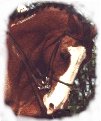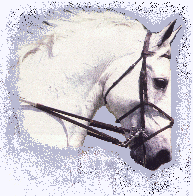
Union Jack - February 27, 1976 - May 6, 2003. Not famous, but well-known especially among the
veterinarians at Texas A&M. He was a solid citizen, a good friend, and a great connoisseur of horse
treats. He lived for several years at Windy Knoll Farm in Magnolia and for his last 14 years at
Cy Creek Ranch in Cypress. Owner: Lou Caldwell
Can Insurance Companies Take Away Your Right to Ride and Be Insured?
You will think I'm making this up, but I'm not. Go to the American Horse Council's web site (www.horsecouncil.org) and click on "Newsroom," and there it is.
This would not be a good thing for the horse industry. Notice there is
a deadline--April 9. I urge you to write some letters--quickly!
Pauline Singleton, Greater Houston Horse Council
Contact: American Horse Council
For Immediate Release
Phone: 202.296.4031
March 26, 2001
Federal Agencies Propose Adverse Rules on Health Insurance
Coverage for Riders
Regulations proposed by the Internal Revenue Service, the Pension and
Welfare Benefits Administration and the Health Care Financing
Administration could affect people who enjoy horseback riding (and other
forms of recreation) by permitting health insurers to exclude coverage
for injuries resulting from riding and other forms of "dangerous"
recreation.
While the new proposals state that an employer cannot refuse health-care
coverage to an employee based on participation in recreational
activities, they permit health insurers to deny coverage for injuries sustained in
connection with such recreational activities, effectively reaching the
same result.
The new regulations were jointly issued by the three federal agencies as
interim rules, which means they are effective now. But the public has
until April 9 to comment on the proposals and such comments will be
considered.
These proposed regulations permit exclusions from health insurance
coverage based on activities, including horseback riding, that Congress
sought to protect. In 1966, Congress passed the Health Insurance
Portability and Accountability Act. As we read this Act, it was
intended to prohibit health insurers from denying health coverage based on a
worker's pre-existing medical condition or participation in legal recreational
activities.
The legislative history of the Act states that the law "is intended to
ensure, among other things, that individuals are not excluded from health-care
coverage due to their participation in activities such as motorcycling,
snowmobiling, all-terrain vehicle riding, horseback riding, skiing and
other
similar activities."
Recreational groups, including the American Horse Council, worked to
have that language included in the legislative history of the Act
because some employers and insurers were discriminating against
recreationalists, leaving them without coverage if they were involved in recreational
pursuits. Incidents of discrimination involved the denial of
health-care protection to employees not only involved in illegal activities, like
driving a car while intoxicated, but also when involved in legal recreational
activities, such as those mentioned above.
While the proposed rules prohibit a person from being denied health
insurance coverage simply because he or she engages in riding, they also
permit an insurer to exclude benefits for injuries suffered while
engaged in such activities. This effectively excludes individuals engaged in such
activities.
The AHC will submit comments to the federal agencies in opposition to
this provision. We urge any individual or equine organization to do
likewise. Comments must be submitted by April 9 to:
CC:M&SP:RU (REG-109707-97)
Room 5226
Internal Revenue Service
P.O. Box 7604
Ben Franklin Station
Washington, DC 20044
U.S. Department of Labor
Pension and Welfare Benefits Administration
200 Constitution Avenue, NW
Room C-5331 - Attention: Nondiscrimination Comments
Washington, DC 20210
Health Care Financing Administration
Department of Health and Human Services
Attention: HCFA-2022-IFC
P.O. Box 26688
Baltimore, MD 21207
A sample letter follows. Please retype it on your stationary and re-draft it to make it as personal as possible. This will give it more weight. Send the same letter to each agency. Do not simply send this memo in to the agencies.
************
Sample letter:
April X, 2001
Address #1:
CC:M&SP:RU (REG-109707-97)
Room 5226
Internal Revenue Service
P.O. Box 7604
Ben Franklin Station
Washington, DC 20044
Address #2:
U.S. Department of Labor
Pension and Welfare Benefits Administration
200 Constitution Avenue, NW
Room C-5331 - Attention: Nondiscrimination Comments
Washington, DC 20210
Address#3:
Health Care Financing Administration
Department of Health and Human Services
Attention: HCFA-2022-IFC
P.O. Box 26688
Baltimore, MD 21207
Dear Sir or Madam:
We are writing in opposition to the non-discrimination regulations under the Health Insurance Portability and Accountability Act (HIPAA) proposed by your agency in January.
Like tens of millions of other Americans we enjoy horseback riding. We participate as follows..... Obviously, if we are unable to purchase health insurance that protects us as we participate in this legal activity, it will affect our continued participation.
These rules will affect more than just us. An economic study commissioned by the American Horse Council shows that recreational horseback riding has a $23.8 billion economic impact in the U.S., supports 317,000 jobs and involves 3 million horses. This segment of the American horse industry is growing rapidly. Horse owners, breeders, stables, outfitters, dude ranches, veterinarians and feed and tack stores all rely on the individual rider. The rules your agency proposes will adversely affect this entire industry.
We support the original Congressional intent of the bill, which is to protect individuals like horseback riders from being discriminated against and denied health insurance coverage simply because they are participating in a legal, recreational activity. We urge you to change the proposed rules to ensure medical coverage, including benefits, for injuries that may occur while riding and engaging in other legal, recreational activities.
Thank you for your consideration.
Sincerely,
Information fron GHHC 02/01: Several rabid skunks have been found in Harris County recently. Skunks do not usually venture out in the daylight.
Should you see one out during the day and it acts sluggish or unusual, call the Houston Department of Health & Humane Services Bureau of
Animal Regulations at 713-238-9600 and an animal control officer will attempt to catch and remove the animal. Also, suspect any downed bats of being rabid. Don't handle them.
Texas Recreational Trails Program awarded the National Forest Service a $100,000 grant to the proposed development of a non-motorized trail system in Sam Houston National Forest in San Jacinto County. They need to come up with $25,000 in matching funds. If you would like to contribute contact: Pauline Singleton, 281-421-2469
Information on Sam Houston National Forest Benefit Trail Ride
28 January, 2001: The Houston Chronicle Texas Magazine gave center page spread coverage to a North American Trail Ride Conference Competitive trail ride in Angelina National Forest near Jasper. The article was written by freelance writer Rogayle Franklin and numerous photographs were printed by Ben Franklin.
USET BOARD VOTES TO CONDITION SETTLEMENT TALKS; MEDIATION
REACHES IMPASSE
Date: 25 Oct 2001
From: AHSAinfo
USA Equestrian (formerly American Horse Shows Association) announced today
that efforts to settle the formal dispute over the status of equestrian
sport's National Governing Body (NGB) before the United States Olympic
Committee (USOC), through mediation, have apparently reached an impasse.
In a trustees' meeting of the United States Equestrian Team (USET) held
yesterday, October 24, 2001, its board voted by a narrow margin to refuse to
engage in further settlement talks with the USOC mediators and USA
Equestrian unless its president, Alan F. Balch, withdraws a motion pending
in New Jersey Superior Court, "immediately dismissing the New Jersey
lawsuit." The motion now pending in Court seeks enforcement of a previous
court order, issued in the case Balch vs. USET, on August 16, 2001,
declaring USET's corporate actions this year "null and void."
Balch explained, "We have continually offered, at USET's request, to ask the
Court to postpone the hearing on the motion until November 16, by which time
we had hoped a settlement could be reached. The Court initially declined to
do so. We then offered to make a further joint plea to the Court. However,
USET apparently refused to consider that option. Our attorneys advise us
that to unilaterally withdraw the motion at this point in the proceedings,
as opposed to postponing it, will prejudice our position. Given the
importance of our case, and the terms of the decision issued August 16, we
simply cannot do so. Our officers are all in agreement on this point."
Nevertheless, as a further gesture of good faith, Balch authorized his New
Jersey attorney to make renewed efforts seeking an adjournment of the
pending motion until November 16. Just after 3 pm today, the Court agreed
to the adjournment. Unfortunately, the USOC mediator has had to notify the
USOC that the mediation appears to be at an end. Armand Leone, Jr.,
president of the USET, had informed the mediators earlier in the day that,
"I am not authorized to proceed any further with negotiations with the
AHSA."
"The foundation of any mediation, working toward a settlement," Balch
stated, "is that neither organization's previously existing position be
prejudiced in any way. That was understood when both USA Equestrian and
USET entered the talks upon conclusion of the USOC hearings in Austin,
Texas, on October 15. Our court motion was pending at the time, and was not
considered an obstacle to settlement discussions then. So obviously
something changed. From what I heard at the USET trustees' meeting
yesterday, it appeared that a majority of the USET board does not want to
consider a settlement along the lines that the mediator, along with the
leadership of both organizations, were in the process of developing. The
demand that we halt our pending litigation is simply unreasonable; it is
neither in our own interest nor the sport's larger interest of assuring
non-profit corporate governance within the law. I would expect the USET to
have the same reaction if our organization were to demand at this point that
the USET drop or withdraw its formal USOC challenge, which began all this
litigation in the first place, back in February."
With the mediation apparently ended, the formal result of the hearing held
before a USOC panel in Austin, Texas, October 13-15, 2001, is expected to be
revealed in due course, barring any further attempts at mediation that still
might be undertaken. It is subject to ratification by the entire USOC board
of directors. Both USET and USA Equestrian have previously waived any right
to further argument or debate before the USOC board of directors, by mutual
agreement with the USOC.
Feb. 23: AHSA approves supplement budget in the face of USET challenge
A special meeting of the American Horse Shows Association (AHSA) Executive Committee was held late on February 22, 2001. Its members voted to approve a supplement to the 2001 budget of approximately $3.5 million, immediately responding to any threat to international athlete funding support that might be caused by the United States Equestrian Team's move to challenge the AHSA's historic status as National Governing Body (NGB) for Equestrian sport.
The special meeting was triggered by a USET trustees telephone conference earlier in the day. USET trustees were advised by Vice Chairman Armand Leone, Jr., that he and Chairman Finn M.W. Caspersen had already signed and submitted a formal challenge of the AHSA's status to the United States Olympic Committee (USOC) without seeking advance approval of the trustees. Upon a motion by USET trustee James Wofford that the USET officers immediately take steps to rescind the challenge, Leone ruled the motion out of order without waiting for a second. During the ensuing discussion, Leone stated that he had been "forced" to commence this litigation since the AHSA/USET Operating Agreement is due to expire Sunday evening, February 25, 2001. AHSA president Alan F. Balch, who is also a USET trustee, asked Leone why the expiration of the Operating Agreement should cause this action, since the USET grew for 46 years without such an agreement with the AHSA. Leone had stated that the USET could not rely on the "whim" of the AHSA's oversight of its activities. At the conclusion of the meeting, Leone accepted a motion by trustee Dorothy A. Matz to endorse the challenge. It passed by a wide margin, but with 4 abstentions and 4 votes against.
The AHSA Executive Committee meeting was noticed to all members of the AHSA Board of Directors, affiliates, athlete leadership, and equestrian media, who were invited to attend the teleconference. The budget supplement was approved on the recommendation of the AHSA Budget and Finance Committee, which had met immediately upon the conclusion of the USET trustees meeting. The supplement approved will authorize investment for new efforts in marketing and development, including staff hiring, to raise the needed funds. The overall budget as approved now forecasts a deficit for the 2001 fiscal year of approximately $17,000 in a total budget of about $15.6 million. The new expenditures will be devoted to international athlete programs and competition, and additional hiring which may be necessary in that area, should the USET withdraw support. Balch emphasized that he saw no reason for the USET to do so, since the AHSA as NGB had always welcomed support by any approved affiliate organization to support international competition efforts for the United States. The USET has historically filled such a role.
A sweeping resolution was also passed by the Executive Committee authorizing the AHSA officers to take any necessary steps to defend the AHSA against the formal challenge by the USET filed with the USOC.
Following the meeting, Balch said, "I want to repeat how disappointed we all
are that the USET has chosen to take this approach to the sport's
governance, as well as by its tone in doing so. But the AHSA has been tested
many times over the decades in protecting the whole sport in the USA, and
has always had the ability to do it effectively. We will continue to welcome
the USET's assistance in supporting our country's international athletes, if
they choose to offer it. A formal challenge can be filed, and it can also be
withdrawn at some point. We continue to believe that a consolidation of the
sport's important governance functions, international, national, and
administrative, is best for its long term health, and we also believe the
law requires it. We'll go forward this weekend to the USOC Membership
Committee with these ideas, while seeing to it that the rights and
opportunities of all equestrian athletes are protected and funded without
interruption. The USOC's procedures for resolving such formal challenges as
the USET has filed will be followed in every respect."
American Horse Shows Association (AHSA)Officers today issued the following statement.
February 1, 2001
The stakes are high regarding the governance issues now pending before the
United States Olympic Committee (USOC). Its decision regarding our NGB
(National Governing Body) status will likely affect every participant in the
sport, from the children in pony rings to the elite athletes. The AHSA has
a duty to bring all relevant information to light, in its role as the
long-standing NGB for the sport, so that everyone in the sport will have the
opportunity to be well-informed. In no way do we intend any informational
effort to be divisive. The debate now underway will bring forward differing
perspectives so that each individual in the sport may discuss the issues at
hand, on the merits.
The facilitated Strategic Planning Process (SPI), underway since November
2000, has been a worthy effort with moments of real progress as both AHSA
and United States Equestrian Team (USET) representatives struggled to set
aside differences and grapple with what is in the best interest of our
sport. However, with the most recent vote of the USET Board indicating its
unwillingness to further consider any merger of the two organizations'
capabilities, we at the AHSA have reached the conclusion that this
collaborative effort has come to a close.
The AHSA is not closing the door on the best thinking and the spirit of a
unified equestrian community that existed at the last meeting of the SPI.
Our next step is to prepare a proposal to be considered by the USOC
Membership and Credentials Committee. The proposal will be inclusive of
many of the best ideas emerging from the SPI while examining and taking
steps to address any governance issues for the AHSA that have been
questioned by the USOC.
We believe, and the Ted Stevens Olympic and Amateur Sports Act along with
the FEI and AHSA rules require, that the NGB of equestrian sport must
fulfill an active leadership role, assuring -
AHSA supports unifying the equestrian sport, providing focus for athletes
and participants at every level and attention across disciplines and breeds,
and expanding the support base to enable more athletes to compete.
Unfortunately, we believe our equestrian sport has for too long been
perceived as an elite sport with competitions often out of the reach of many
who might otherwise be qualified to excel.
At the same time, we also know the financial capability to nurture and field
world class teams is critical to success. We believe a broad-based
financial program managed by a unified organization with financialstability, solid infrastructure and sound stewardship can best do this for
today's athletes and tomorrow's. Our sense of today and our wish for the
future both prompt us to think about how our sport is funded and how it is
perceived and marketed. We believe there is an exciting opportunity to
raise awareness and enthusiasm, funds from many sources, and the support
necessary to enhance our new profile and our competitive excellence.
We continue to encourage the USET to consider joining the best of its
capabilities with the best of ours. As the next few weeks unfold, we will
flesh out the most basic concepts for the USOC to consider. One is a
potential consolidation of organizational capabilities with a minimum of
disruption - a transformed NGB with full responsibility for today's
stewardship of the sport and a vision for tomorrow's potential.
We must fulfill the USOC's mandate for governance of the sport. Even if the
USOC did not require it, the AHSA believes that having a single,
consolidated organization as the NGB is in the best interest of the sport
long-term. The time has long since come for unified, aggressive management
of the total sport - harnessing all of the financial, operational,
marketing, and human resource strengths that implies - to generate the
public interest and revenue needed to support every participant. Our
proposal will include a structure that guarantees focus for athletes and
participants at every level - from beginner to Olympian - and attention
across both national and international disciplines and breeds.
The "pyramid" of the sport - athletes and other participants that we serve -
needs to be inclusive, not exclusive. The governance of the sport needs to
be democratic, not elitist. If the top of the sport pyramid is cut off to
stand by itself, it is still a pyramid, but is a small one among the giants
of other sports in the Olympic movement. Equestrian sport is small enough
as it is now in comparison with other sports. Why divide it further?
We believe that finger-pointing is not constructive. We will engage our
membership through increased communication, as time permits, in a positive
and informative way.
We hope the principles outlined here can clear the air and allow the focus
to be on what is best for the sport. Your thoughts are welcome as we work
to enhance the AHSA proposal in preparation for our February 24, 2001
meeting with the USOC.
The Officers of the AHSA, with address and discipline affiliations, are:
AHSA PRESENTS PROPOSAL FOR SINGLE, UNIFIED STRUCTURE FOR THE SPORT
A Proposal for a Single, Unified Structure for Equestrian Sport was made by
the American Horse Shows Association members on the AHSA/USET (United States
Equestrian Team) Strategic Planning Initiative Drafting Task Force to the
AHSA Board Of Directors meeting on Thursday, January 11, 2001 at the AHSA
Annual Convention in Colorado Springs, CO.
The latest draft of the document is attached and reflects changes to the
original following input from the AHSA Board of Directors and a subsequent
meeting of the Strategic Planning Initiative Drafting Task Force.
The document (draft of Jan 14, 2001), together with an accompanying cover
letter, is also available on the AHSA web site at: www.ahsa.org/EquestrianGovernance/index.html
RELEASE: January 24, 2001
The American Horse Shows Association (AHSA) announced today that the
facilitated Strategic Planning Initiative (SPI) to consider the future
governance of equestrian sport, commenced in early October under auspices of
the United States Olympic Committee (USOC), is apparently at an end.
James C. Wofford and Katharine E. Jackson, AHSA's representatives to the SPI
Steering Committee, said that actions taken by the trustees of the United
States Equestrian Team (USET) at a meeting in Florida on Monday, January 22,
2001, apparently ended the effort. "The USET trustees were urged to vote
between options which we thought were to be presented to them only for
suggestions and comment," said Jackson. "Our clear mutual understanding
within the SPI task force on January 9 was that the options were to be
presented to the boards of the AHSA and USET in person, for input and
discussion, not votes, so that we could continue to come together for the
good of the sport. However, the USET leadership recommended a
confrontational path instead."
The USET trustees voted by a wide margin Monday to endorse an option for the
governance of the sport calling for the USET to be re-named, and then seek
to become the National Governing Body (NGB) for equestrian sport, reversing
roles with the AHSA, which has been NGB since the term was codified in
federal law in 1978.
"Monday was a sad day for all horsemen," said Alan F. Balch, AHSA president.
"The USET's action is divisive, and pits organization against organization,
horseman against horseman, and athlete against athlete. The proposal
presented Monday was another variation of what has changed each time we've
seen it. It is exclusionary, elitist, and adversarial. It seeks to raise
funding for new USET functions on the back of international and aspiring
athletes, claiming to generate nearly $1.5 million in new funds through a
combination of new fees on international competitors, young riders, juniors,
and owners, $100 mandatory membership fees, and $15 per horse drug fees, as
well as removing hundreds of thousands of dollars in existing revenues from
the AHSA. I don't think it will stand scrutiny, and I don't think it is
practical. Many of those who would have to pay these added fees have
objected to the existing fees charged by the AHSA as too high right now.
Worse, this plan won't come close to raising what the USET would really
need. I would say it relies on a seriously flawed business model."
Balch said that the AHSA will announce its final plans for meeting the NGB
compliance requirements of the USOC in the very near future. "We are now
scheduling new meetings of our national and international affiliate
organizations, officers, and directors. Personally, I am disappointed that
the USET has chosen the path it has, refusing the option of consolidation
with the AHSA. There can be no question that that would have been the most
efficient and positive outcome of the strategic planning process. The
option we preferred was inclusive, democratic, and conciliatory, and
provided a framework of complete access to all equestrian functions,
throughout the entire pyramid from grass roots to elite, by all members and
adherents of the sport."
For more information, please contact Christine E. Stafford, Director of
Communications on 859-225-6923 or via email at cstafford@ahsa.org. AHSA
press releases are available on our web site - www.ahsa.org
.
Feed Contamination Issue Resolved by FDA
Although many of you may have heard the latest regarding the resolution of the cattle feed contamination situation in Texas, I wanted to ensure that you received this statement issued by the Food and Drug Administration (FDA), the agency in charge of regulating feed components. The FDA has said the cattle involved are to be rendered and the material will not enter ruminant or human food channels. The Texas Animal Health Commission (TAHC) will provided assistance to the FDA as requested and needed.
FDA ANNOUNCES TEST RESULTS FROM TEXAS FEED LOT
Today (Tuesday, 30 Jan.) the Food and Drug Administration announced the
results of tests taken on feed used at a Texas feedlot that was suspected
of containing meat and bone meal from other domestic cattle -- a violation
of FDA's 1997 prohibition on using ruminant material in feed for other
ruminants. Results indicate that a very low level of prohibited material
was found in the feed fed to cattle.
FDA has determined that each animal could have consumed, at most and in
total, five-and-one-half grams - approximately a quarter ounce -- of
prohibited material. These animals weigh approximately 600 pounds.
It is important to note that the prohibited material was domestic in origin
(therefore not likely to contain infected material because there is no
evidence of BSE in U.S. cattle), fed at a very low level, and fed only
once. The potential risk of BSE to such cattle is therefore exceedingly
low, even if the feed were contaminated.
According to Dr. Bernard Schwetz, FDA's Acting Principal Deputy
Commissioner, "The challenge to regulators and industry is to keep this
disease out of the United States. One important defense is to prohibit the
use of any ruminant animal materials in feed for other ruminant animals.
Combined with other steps, like U.S. Department of Agriculture's (USDA) ban
on the importation of live ruminant animals from affected countries, these
steps represent a series of protections, to keep American cattle free of
BSE."
Despite this negligible risk, Purina Mills, Inc., is nonetheless announcing
that it is voluntarily purchasing all 1,222 of the animals held in Texas
and mistakenly fed the animal feed containing the prohibited material.
Therefore, meat from those animals will not enter the human food supply.
FDA believes any cattle that did not consume feed containing the prohibited
material are unaffected by this incident, and should be handled in the beef
supply clearance process as usual.
FDA believes that Purina Mills has behaved responsibly by first reporting
the human error that resulted in the misformulation of the animal feed
supplement and then by working closely with State and Federal authorities.
This episode indicates that the multi-layered safeguard system put into
place is essential for protecting the food supply and that continued
vigilance needs to be taken, by all concerned, to ensure these rules are
followed routinely.
FDA will continue working with USDA as well as state and local officials to
ensure that companies and individuals comply with all laws and regulations
designed to protect the U.S. food supply.
Texas Animal Health Commission
Box l2966, Austin, Texas 78711, (800) 550-8242, FAX (512) 719-0719
Linda Logan, DVM, PhD, Executive Director
For info, contact Carla Everett, information officer, at 1-800-550-8242,
ext. 710, or email: ceverett@tahc.state.tx.us
From the Texas Animal Health Commission (26 January, 2001):
During the past 48 hours, the media has focused on a situation
in Texas regarding a possible feed contamination issue. We are
taking this opportunity to advise you of the facts surrounding
this situation, in order to avert undue concern:
According to reports from the Food and Drug Administration (FDA), about
a week ago, some cattle in a Texas feedlot may have consumed some
feed that contained mammalian protein (meat and bone meal). Since
l997, the FDA has banned mammalian protein in feed for ruminants
(multi-stomached animals), such as cattle.
The error was noted within hours and was reported by the feed manufacturer
to the FDA. The use of the lot of feed in question was suspended and
the feedlot is voluntarily holding the cattle on site. The FDA is analyzing
samples of the feed. The feed analysis should be complete
by Monday evening, January 29, 2001, at which time, the FDA will evaluate
the next step regarding these animals. FDA officials expect to make
a decision regarding the animals by Jan. 31.
Some salient points:
Please refer interested parties to Mr. Lawrence Bachorik,
at the Food and Drug Administration, which is in charge of this
situation. Mr. Bachorik's number is 1-301-827-6250. Carla Everett,
public info officer at the TAHC, can be reached at 1-800-550-8242,
ext 710.
Germany Wins 5th Straight Team Dressage Gold!
Netherlands wins Team Silver and USA wins Team Bronze for 3rd Olympics in a row.
See full story in The Chronicel of the Horse
Individual Dressage on Friday.
In Dressage Individual Musical Freestyle, Anky van Grinsven of the Netherlands on Bonfire win the Gold.
Isabell Werth of Germany on Gigolo win the Silver and Ulla Salzgeber of Germany on Rusty win the Bronze.
USA's Susan Blinks on Flim Flam came in 8th and Christine Traurig on Etienne came in 11th.
U.S. Three-Day Eventing Team brings home the Bronze! Australians make it Gold for 3 years straight.
David O'Connor brings home the first 3-Day Individual Gold Medal for the U.S in 25 years!
Three-Day Eventing Individual: David O'Connor and Custom Made receive the best dressage score ever: 29 penalty points!
Official Sydney 2000 Olympics Site
Click here for more news and information on 2000 Olympics and the U.S. Equestrian Team.
Click here for "The Chronicle of the Horse" website for up-to-date results
British Parliament to debate a ban on hunting, particularly foxhunting. If you would like to support the cause of hunters you can send donations to:
The Countryside Alliance,
The Old Town,
367 Kennington Road,
London, SE11 4PT,
UK
or phone: 011-44-20-7840-9200.
The Houston Dressage Society and all who knew him mourn the passing of Forget Not, known affectionately as: Chunky. He was an Anglo-Clydesdale gelding by Strider (TB) out of Lorna Doone, Clydesdale mare bred by Virginia Campbell Scott of Dalriada Farm in Pearland. The first of Virginia's "great experiment" to breed Texas Warmbloods. There were four offspring from this original TB/Cyldedale cross: three colts and one filly. Chunky was the one to leave home; shown in hunter, then in cross country and dressage by Cara Campbell, Virginbia's sister and trained to Grand Prix Dressage by Fran Dearing of Windy Knoll Farm, Magnolia.
Chunky upheld the Texas honor at the Insilco Dressage Championships under Cara at winning thrid place overall in a real head-to-head national dressage championship at Second Level.
Later he went on to be Fran Deaing's Grand Prix model winning the hearts of the audience with his wonderful freestyle to the strains of the Budweiser Beer commercial.
Chunky has been in his retirement years teaching a few lucky students what it was like to ride a Grand Prix horse. He will be missed.
(For more on Forget Not.)
BIG BEN. The world lost one of show jumping's great equine heroes in December at the age of 23. Big Ben died from an untreatable case of colic.
Paired with Ian Millar, Big Ben represented Canada and brought home the individual and team medals in the Olympic Games in 1984, 1988 and 1992, the1986 World Championships and the 1987 PanAm Games. And won back-to-back World Cups in 1988and 1989.
Big Ben was a huge Belgian Warmblood over 17 hands. Even after retirement in 1994 he continued to receive honors. Big Ben was awarded a sports heroes' highest honor by being inducted into Canada's Sports Hall of Fame along with Ian Millar. Ben was only the second non-human to receive this honor.the other being the great racehorse, Northen Dancer.
In 1999 Canada issued a postage stamp to his honor.
Big Ben was buried on Millar's farm in Ontario.

ABDULLAH. January 5 the sporthorse world lost a great performance stallion and sire as the result of complications from emergency colic surgery.
Abdullah is best known as the individual silver medal winner at the 1984 Los Angeles Olympic Games. Paired with Conrad Homfeld, the striking gray Trakehner stallion made Olympic history along with Homfeld's training partner Joe Fargis and the Thoroughbred mare, Touch of Class who won the individual gold,enabling the US to win the team gold for 1984.
In 1985 Abdullah won the FEI World Cup and in 1986 won the team gold and individual silver in the World Championships.
Abdullah was a breeding stallion throughout his career; a successful and popular sire of hunters, jumpers and event horses.

Judi Mc Gee Holmes and Peter Pletcher standing with Geste, winner of the $30,000 Madison Square Garden Hunter Classic and National Horse Show Regular Working Hunter Champion. Photo by Trisha Booker.
Peter Pletcher trains from his PJP Farms, Inc. in Magnolia, Texas, and is known not only for his hunter rider/trainer skills but also in the jumper division winning the 1991 President's Cup at the Washington International on Uncle Sam.
See The Chronilce of the Horse online.
Robin Devin, Youth Director for the American Quarter Horse Association, stated after seeing the video, "Every young person and their parents who are involved in a youth horse program should see this video."
To order a copy contact:
Instructional Materials Service
Texas A&M University
College Station, TX 77843-2588
Phone: 409-845-6601; Fax: 409-845-6608
E-mail: ims@tamu.edu
Website with ordering information: www-ims.tamu.edu
"Horse, Kids & Ethics" catalog #9563
$55.00 plus 10% for shipping and handling
Among the items on the agenda were proposed changes to the Equine Infections Anemia Regulations (EIA, swamp fever, or "Coggins"). In January, the commissioners proposed to drop the exemption which allows sale barns to sell horses untested for EIA. Many of us had high hopes that this proposal would pass, and the exemption would be eliminated.
A strange atmosphere prevailed. As always, when the topic comes up, the Livestock Marketers Association and others affiliated with the auction industry were there in force. The meeting commenced very promptly and the EIA questions were moved from fourteenth (14th) on the agenda to first (1st) on the list.
The livestock marketing industry had accumulated approximately 2400 signatures on petitions supporting the retention of the exemption; horse industry people commenting in favor of dropping it (teh exemption) numbrerd more than 4000.
(The official TAHC press release says "Comments were split for and against this test requirement." That sounds like it was an even split, doesn't it? That 4000 signatures does not include those on the petitions which I dropped on their desk that morning. The horse marketers were out voted by a solid margin, for what it's worth. One is left to speculate why the TAHC office tries to create the impression that it was an even split.) [THD italics, not Ms. Singleton's.]
A motion was made to table the matter of the exemption indefinitely and the motion was immediately adopted by unanimous vote. (TAHC Committee) Chairman Rob Brown asked for those visitors who supported the motion to stand, and then for those opposed to stand. No doubt this exercise was pleasing to the livestock marketers. Chairman Brown indicated that public testimony would not be taken at this time, but that anyone wishing to stay until the end of the meeting was welcome to stay and say whatever he or she wished. Rusty Addison, spokesman for the horse marketers, thanked the commission profusely and advised them that by voting to table the proposal they had spared themselves four or so hours of testimony by him and his associates. Well, I will have to say that listening to them for four hours would have been a pretty grim experience.
Horse owners and the horse industry representatives were left to ponder this amazing turn of events. I strongly suspect the interference of one or more legislators with the workings of the TAHC. My hunches have been pretty accurate along these lines in the past.
Let us not forget our dear friend, Representative L.P. "Pete" Patterson, who is responsible for the sale barn exemption in the first place. I suspect this is still the root of the problem. And let us not forget that Patterson aspires to be Texas' next Agriculture Commissioner. He is opposed by Susan Combs. Remember this come November!!!
Meanwhile, after the smoke clears, maybe we can uncover more useful information about this rather bizarre retreat on the part of the Texas Animal Health Commission. There is more going on here than meets the eye.
I want to thank everyone who took the time to comment to the TAHC, whether the comment consisted of a signature on a petition, a letter, or a personal appearance. I would also encourage anyone who has not expressed his opinion to do so. The final chapter of this saga has not been written.
Pauline Singleton, EIA Committee Chair, Greater Houston Horse Council
281-421-2469; e-mail: pcsing@hal-pc.org
Texas Horseman's Directory editorial opinion: As a horse person, I am outraged with this turn of events but not especially surprised. The horse industry in Texas is being run by a "good ole boy" network that wants to maintain the statis quo; that is, they do not want to move into the 20th Century much less the 21st Century.
Horses are no longer just livestock numbers to be used and thrown away in the most profitable manner possible. The greatest majority of horses today exist for the pleasure of their owners and are more pet and companion than a livestock animal. The barnyard owner, the playday owner, the local show owner, the "A" show owner are all being victimized by these "good old boys".
If you sell a horse to your neighbor you must have proof of a negative "Coggins Test"; if you go on a trail ride or enter ANY kind of competition, be it a fair or a show, you must have proof of a negative "Coggins Test"; if you want to compete in another state you better have proof of a negative "Coggins Test" or they might not even let you into the state.
But, if you have a "ranch horse" it is exempt; if you want to run a sale barn you can sell anything you want. Then you are told to get that horse checked ASAP. What do you do if it comes back EIA POSITIVE? I want to see you try to take it back to the sale barn and then have them check ALL of the horses that were in the sale barn at the same time as that horse. You will notice that reputable horse sales at horse show facilities always require proof of a negative "Coggins Test". No horse sales will be posted on the Texas Horseman's Directory "Show & Clinic Schedule" unless they require a negative "Coggins".
Call, write, e-mail the TAHC and express your outrage. And please vote for Susan Combs in November for Agriculture Commissioner.
You can contact the TAHC at:
TAHC Equine Committee
Box 12966
Austin, TX 78711-2966
or call: 512-719-0700
or view their website at:
http://www.tahc.state.tx.us and express your opinion.
An EIA test within the past 12 months is also required when equine are privately sold, explained Dr. Terry Beals, TAHC executive director and state veterinarian. He said sellers and buyers can decide who will pay for the test, which runs around $20 - $25 for an accredited veterianarian to draw and submit a blood sample, complete the necessary test record and the cost of the laboratory work.
"When equine are sold at livestock markets or at regularly scheduled horse auctions, the test is not required, but the buyer will be informed that the health status of tha animal is uncertain," said Dr. Beals. For several months, earlier this year, TAHC commissioners and an appointed ad-hoc committee representing the equine industry struggled with this issue, he said.*
"Market owners were greatly concerned about potential loss of business if a test had to be run prior to selling a horse. The business owners also worried about the expense of setting up a laboratory at the sale. The compromise worked out with the markets will require notifying the buyer that the animal is untested and a TAHC disease information sheet will be stapled to the receipt. The pamphlet urges the owner to quarantine the equine until a negative test is obtained and discusses the consequences of having an infected animal," Dr. Beals said.
"The TAHC has worked with markets to identify horse with back tags and since 1997 had been testing Texas horses at the two Texas slaughter plants that handle equine," he explained. "This testing allows infected animals to be traced back to their home premise, where additional infection may be found. Our field staff will also be checking markets for compliance with the regulations after July 1."
"More than 550 infected equine have been detected in Texas since September 1, 1996," Dr. Beals pointed out. "Of course, we're testing record numbers of equine this year, because in the past, mostly animals going out of state or to a multi-state competition were tested. Now with widespread testing, we're getting a clearer picture of the disease situation and finding reservoirs of infection that otherwise might never have been detected."
"Until 1997, about 80,000 Texas horses were tested for EIA each year. In the first five months of 1997, January through May, nearly 100,000 equine were tested during the EIA testing regulation "phase-in" period when voluntary compliance was requested," said Dr. Beals.
"Just looking at an equine will not tell someone if the animal is infected. In some cases, the infection causes an equine to develop fever, weight loss and severe anemia. However, many infected equine have symptoms only when they are overworked, stressed or injured, and then they may recover," he said. "Finally, there are animals that show no signs of illness. These inapparent carriers still can be instrumental in spreading infection."
"All EIA-infected animals should be considered dangerous, as they pose a threat to "clean" equine. There is no effective vaccine, treatment or cure for EIA," said Dr. Beals. "Infected equine must be permanently identified and are restricted under quarantine to their premise."
He explained that as long as infected animals stay on the premise, all other equine on the ranch or farm also are quarantined. Infected equine can be removed by having them euthanized, or having them permitted to a research center, a market for sale to slaughter or for direct shipment to slaughter. Sixty days after infected equine are removed, the remaining equine on the premise can be tested again. Dr Beals said that if those
equine test negative for EIA, the quarantine is lifted and the animals may be moved freely.
*
Editorial Opinion: The TAHC sold out to the sale barns. To buy a horse at a sale barn, without it being tested is like playing Russian Roullet. If you buy a horse at a sale barn and take it home and find it tests EIA-positive do you get your money back? No one in his right mind would buy an EIA-positve horse knowingly. Then if this happens are they going to be able to track down every horse that was at the auction and where every horse came from to find the carrier? Will people comply when they have their horse at home?IMHO it is much better to place the same requirements on the businesses that you place on private sales. Is a professional trainer or breeder a private sale? Why must they bear the burden the other "professional sale barns" do not have to bear?
The sale barns say they would loose business to have to turn away those untested horses. They might at first, but soon the word would get around that if you wanted to sell a horse it had to be tested BEFORE it went to sale.
It is the opinion of the Texas Horseman's Directory that if you want to buy a horse DO NOT buy from any sale auction that does not require a negative "Coggins" of all equines passing through its doors. It is too big of a risk.
TAHC's Ad Hoc Equine Committee Members
Chairs: Mr. Rob Brown, TAHC Chairman & Equine industry representative and
Dr. Dick Sherron, public member on TAHC commission
Committee Members: Keith Chapman, Livestock Marketing Assoc. of Texas
Dr. Doug Householder, equine specialist, Texas A&M's Extension Service
Dr. Allan Oltjen, Texas Veterinary Medical Association
Mr. Jack Aufill, Mr. Bobby Edmond, Mr. Rusty Addison, Texas Horse Marketers' Association
Mr. Jim Kelley, Texas Paint Horse Association
Mr. Jeff True, Texas Quarter Horse Association
Mr. Curtis Kidd, Texas Thoroughbred Breeders' Association
Mr. Ed Small, Texas & Southwestern Cattle Raisers' Assocaition
Mr. Jim Short, National Cutting Horse Association
Mr. Elton Brown, Northeast Texas Horse Owners Association
Dr. Jake Sherwood, representing EIA laboratories
FOR FURTHER INFORMATION:
Contact the Texas Animal Health Commission, Box 12966, Austin, TX 78711-2966,
or call: 512-719-0700.